
Introduction: What Is the Sun Crossword?
If you’ve ever picked up a copy of The Sun newspaper — one of the United Kingdom’s most widely read tabloids — chances are your eyes have drifted toward the crossword page. The Sun Crossword is a daily word puzzle published by The Sun newspaper and its digital platforms, designed to challenge, entertain, and engage readers of all ages and ability levels.
Unlike some of the more cryptic and intimidating crosswords found in broadsheet newspapers, the Sun Crossword strikes a perfect balance between accessibility and intellectual challenge. It is beloved by casual players who just want to relax with a cup of tea and by serious puzzlers who chase the daily completion streak. Whether you’re brand new to crosswords or a seasoned solver, the Sun Crossword has something for you.
In this comprehensive guide, we’ll cover everything — from what the Sun Crossword actually is, to why millions of people are addicted to it, to how you can start solving it yourself using proven strategies. Let’s dive in.
Why the Sun Crossword Is So Popular
There’s a reason the Sun Crossword has maintained its loyal readership for decades. Its popularity isn’t accidental — it’s the result of smart puzzle design, consistent daily availability, and a format that appeals to a massive demographic.
Wide Accessibility: The Sun is one of the most widely read newspapers in the UK, meaning the crossword reaches a huge audience daily. Its digital presence has expanded that reach globally.
Varied Difficulty Levels: The Sun offers different styles of crosswords — from quick puzzles for beginners to more challenging cryptic varieties. This range means that no matter where you are on your solving journey, there’s a Sun puzzle for you.
Daily Consistency: A fresh puzzle every single day gives solvers something to look forward to. Routine is powerful, and the Sun Crossword has become a daily ritual for millions.
Mental Stimulation: At a time when screen time is dominated by passive consumption, crosswords offer active mental engagement. The Sun’s puzzles are a healthy brain workout disguised as entertainment.
Community and Culture: There’s a social element to crossword solving — sharing tricky clues with friends, comparing completion times, and talking about particularly clever answers. The Sun Crossword is a shared cultural touchpoint, especially in British households.
Types of Sun Crossword Puzzles
The Sun doesn’t just publish one type of crossword — it offers a variety of puzzle formats to keep things fresh and cater to different solver preferences.
The Sun Quick Crossword is the most beginner-friendly option. Clues are straightforward definitions, and the answers are everyday words. This is the perfect starting point for anyone new to crosswords.
The Sun Cryptic Crossword is a step up in difficulty. Each clue contains a hidden wordplay element — such as anagrams, hidden words, double definitions, or homophones — alongside a straight definition. Solving cryptics is a skill that takes time to develop, but it’s incredibly rewarding.
The Sun Two-Speed Crossword is a clever hybrid format. Each clue is written in two ways: one straightforward and one cryptic. You can choose which version suits your current mood or skill level, making it one of the most flexible puzzles available.
The Sun Coffee Time Crossword is a lighter, more relaxed puzzle designed for shorter solving sessions. Think of it as the midday snack of crosswords — satisfying without being overwhelming.
The Sun Prize Crossword offers the added excitement of competition. Correct entries are submitted for a chance to win prizes, adding a fun incentive layer to the usual solving experience.
How the Sun Crossword Works
Understanding the structure of a crossword puzzle is the first step toward solving it effectively. Here’s a breakdown of how the Sun Crossword is laid out and how it functions.
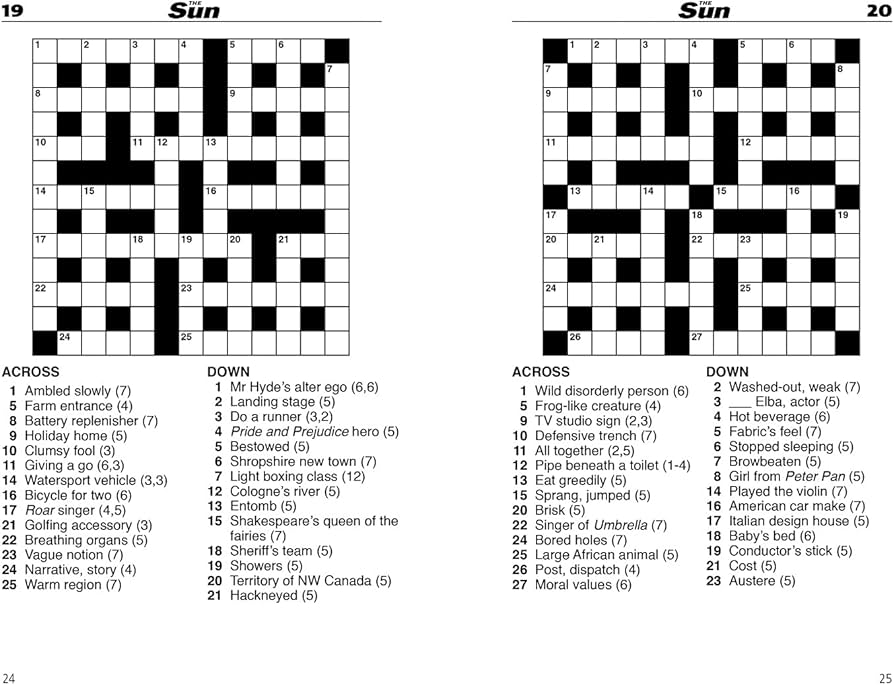
A standard crossword grid consists of black and white squares arranged in a symmetrical pattern. White squares are where you write your answers, and black squares act as dividers between words. Each answer slot is numbered, corresponding to a clue in the Across or Down list.
Across clues are answered by words that run left to right horizontally across the grid. Down clues are answered by words that run top to bottom vertically. Each clue is numbered to match its position in the grid, so “1 Across” starts at square number 1 and runs horizontally until it hits a black square.
In a Quick Crossword, clues are direct synonym-based hints. For example: Capital of France (5) — the answer is PARIS, five letters. The number in brackets always tells you how many letters the answer contains, which is one of the most useful pieces of information a solver has.
In a Cryptic Crossword, each clue has two parts: the definition (which appears at the start or end of the clue) and the wordplay (which leads you to the answer through linguistic trickery). Spotting where one ends and the other begins is the core skill of cryptic solving.
Step-by-Step Guide to Solving the Sun Crossword
Whether you’re new to crosswords or looking to sharpen your skills, following a systematic approach makes a significant difference. Here’s a clear, actionable step-by-step guide to solving the Sun Crossword.
Step 1: Scan the Entire Puzzle First
Before writing a single letter, read through all the clues. Don’t try to solve anything yet — just get a feel for the puzzle. Your brain will begin working on clues in the background even while you continue scanning. You may notice that certain clues feel immediately familiar. Mark those mentally (or lightly in pencil).
Step 2: Start with What You Know
Begin with the clues you’re most confident about. These are your “giveaways” — the answers you know immediately without any deliberation. Fill these in first. Even a handful of correct answers will unlock crossing letters in other words, giving you invaluable hints for the clues you’re less sure about.
Step 3: Use Crossing Letters
Once you’ve filled in several confident answers, look at the letters that appear in crossing words. If you have three out of five letters in a word, your options narrow dramatically. Use those crossing letters to guide your guesses for uncertain answers.
Step 4: Think About Word Length
The number in brackets after each clue tells you exactly how many letters the answer contains. This is enormously helpful. If you know an answer is seven letters long and starts with “P,” you’ve already significantly limited the possibilities.
Step 5: Look for Common Crossword Words
Over time, you’ll notice that certain words appear in crosswords repeatedly. Words like ERA, ORE, ALE, EEL, ARIA, OLEO, and similar short, vowel-heavy words are crossword staples. Recognizing these patterns speeds up your solving considerably.
Step 6: Work Systematically Through Uncertain Clues
After picking the low-hanging fruit, return to the clues you skipped. Apply logic: what letters do you have so far? What words fit this pattern? Can you eliminate any options? Work methodically rather than jumping randomly between clues.
Step 7: For Cryptics, Identify the Clue Type
If you’re solving a cryptic, your first job with each clue is to identify what type of wordplay is being used. Is it an anagram (look for indicator words like “mixed,” “broken,” “confused”)? A hidden word (“in part,” “within,” “some of”)? A homophone (“sounds like,” “they say”)? Identifying the wordplay type unlocks the path to the answer.
Step 8: Take a Break If You’re Stuck
Stepping away from a challenging puzzle and returning with fresh eyes is a legitimate strategy — not a defeat. Your brain continues processing in the background. Many solvers find that answers they couldn’t see before become obvious after a short break.
Step 9: Verify Your Completed Grid
Once you’ve filled in all squares, read through your answers one more time. Make sure everything makes sense both Across and Down. A completed grid where every crossing letter matches is a strong indicator that you’ve solved it correctly.
Pro Tips to Solve Sun Crossword Faster
Beyond the basic step-by-step process, experienced solvers use specific techniques to improve their speed and accuracy.
Build your vocabulary deliberately. The more words you know, the more clues you can answer instantly. Reading widely — fiction, non-fiction, news — exposes you to language in varied contexts and naturally expands your word bank.
Learn common crossword abbreviations. Setters frequently use abbreviations as part of clue wordplay. For example, “doctor” might indicate DR, “note” could mean DO, RE, MI, FA, or SI, and “direction” often means N, S, E, or W. Memorizing these conventions saves time.
Study anagram indicators for cryptics. Words like “scrambled,” “jumbled,” “upset,” “wild,” “around,” and dozens of others signal anagrams in cryptic clues. Building a mental list of these indicators is one of the highest-value skills a cryptic solver can develop.
Use a pencil, not a pen. This seems minor, but writing in pencil allows you to erase mistakes without the grid becoming a mess. It also psychologically lowers the barrier to trying an answer you’re uncertain about.
Keep a crossword notebook. When you look up an answer or encounter a word you didn’t know, write it down. Over time, this notebook becomes a personalized reference guide filled with exactly the knowledge that catches you out repeatedly.
Solve at the same time each day. Building the Sun Crossword into a daily routine — morning coffee, lunch break, commute — helps your brain slip into “puzzle mode” more quickly and consistently.
Practice themed puzzles. Many crosswords have themes — all long answers might be connected to a common concept. Spotting the theme early can give you a massive head start on the longer, thematic answers.
Common Mistakes to Avoid
Even experienced solvers make avoidable errors. Being aware of these pitfalls can save you significant frustration.
Writing answers in pen before you’re confident is a classic beginner mistake. It creates a messy grid and can lock you into wrong answers. Always use pencil until you’re certain.
Tunnel vision on a single difficult clue wastes valuable time. If you’re spending too long on one answer, move on. Crossing letters from other answers often make the hard clue obvious later.
Ignoring the letter count is surprisingly common. Solvers sometimes fall in love with an answer that doesn’t fit the given letter count. The bracket number is gospel — if it doesn’t fit, it’s wrong, no matter how good it sounds.
In cryptic crosswords, trying to read the whole clue as a single straightforward definition leads nowhere. You must identify the two separate components — the definition and the wordplay — and work with them independently.
How to Access the Sun Crossword
One of the great advantages of the Sun Crossword in the modern era is how easy it is to access. You no longer need to buy a physical newspaper every morning.
The crossword is available in the print edition of The Sun newspaper, published daily across the UK. Digitally, it can be accessed through The Sun’s official website (thesun.co.uk), where puzzles are regularly updated. The Sun also has a dedicated Sun Crossword app available on both iOS and Android devices, offering a clean, user-friendly interface with daily puzzle updates, tracking features, and the ability to check answers or get hints.
Additionally, some third-party crossword apps and puzzle aggregators feature Sun Crossword content, though always verify these are officially licensed to ensure you’re getting the authentic puzzle experience.
Sun Crossword vs. Other Crosswords
How does the Sun Crossword stack up against other popular crossword options? Here’s a quick comparison.
The New York Times Crossword is considered the gold standard in American crosswords. Its Monday puzzles are beginner-friendly, increasing in difficulty through to Saturday’s fiendish challenge and Sunday’s larger-format puzzle. The NYT crossword tends to include more American cultural references and contemporary pop culture compared to the Sun.
The Times Cryptic (from The Times of London) is widely regarded as one of the most prestigious cryptic crosswords in the world. It’s significantly harder than the Sun Cryptic and is best approached by experienced cryptic solvers.
The Guardian Cryptic is known for its creative, sometimes experimental clue writing and its willingness to embrace humor and unconventional themes. It’s well-loved among dedicated cryptic enthusiasts.
The Sun Crossword’s advantage is its approachability and variety. By offering multiple formats at different difficulty levels — from Coffee Time to the full Cryptic — it serves the broadest possible audience and makes crossword solving genuinely inclusive.
Benefits of Solving Crossword Puzzles
The case for doing crosswords extends well beyond entertainment. Research has consistently supported the cognitive and psychological benefits of regular puzzle solving.
Crosswords are a proven workout for your memory and recall. The act of retrieving words from your memory and fitting them into specific letter patterns actively exercises the retrieval pathways in your brain, keeping them strong and efficient. Studies have suggested that regular engagement with word puzzles may help delay cognitive decline in older adults.
Solving crosswords also builds vocabulary organically. Encountering unfamiliar words in the context of a puzzle — and then looking them up to understand them — is one of the most effective forms of vocabulary acquisition available to adults.
There’s a genuine mindfulness element to crossword solving, too. The focused concentration required pushes out other thoughts and stresses, creating a state of calm engagement similar to meditation. Many solvers describe the experience as genuinely relaxing, even when individual clues are frustrating.
Finally, there’s the simple satisfaction of completion. Finishing a crossword — especially a challenging one — delivers a real sense of achievement. That small daily win can be surprisingly powerful for mood and motivation.
Wrap-Up
The Sun Crossword is far more than a daily newspaper filler — it’s a richly rewarding mental exercise, a beloved daily ritual, and a gateway to lifelong love of language and wordplay. Whether you’re drawn in by the Quick Crossword’s approachable charm, the cryptic’s tantalizing complexity, or the Two-Speed’s flexible format, there’s a Sun puzzle perfectly calibrated to your current skill level and mood.
The key takeaways from this guide are simple: start with what you know, use crossing letters strategically, learn the conventions of cryptic wordplay if you want to tackle those puzzles, and practice consistently. Like any skill, crossword solving improves with time and repetition. The more puzzles you attempt, the broader your vocabulary becomes, the more patterns you recognize, and the faster and more confidently you solve.
Frequently Asked Questions (FAQs)
Q1: Is the Sun Crossword free to access online?
Some Sun Crossword puzzles are available for free on thesun.co.uk, while others may require a Sun+ subscription for full access. The app version offers both free daily puzzles and premium content depending on your subscription tier.
Q2: How often is a new Sun Crossword published?
A new crossword puzzle is published every day, seven days a week. Different puzzle types (Quick, Cryptic, Two-Speed, etc.) rotate on different schedules, but there is always fresh content available daily.
Q3: I’m a complete beginner. Which Sun Crossword should I start with?
Start with the Sun Quick Crossword. Its straightforward definition-based clues are the best introduction to crossword solving, allowing you to build vocabulary, grid-reading skills, and confidence before tackling more complex formats.
Q4: What does the number in brackets after a clue mean?
The number in brackets tells you how many letters are in the answer. For example, (5) means a five-letter word. If you see (3,4), the answer is a two-word phrase with three letters in the first word and four in the second.
Q5: What are the most common wordplay types in the Sun Cryptic Crossword?
The most frequently used cryptic wordplay types are anagrams, hidden words, charades (stringing parts of words together), double definitions, homophones, containers (one word inside another), and reversals. Learning to identify these types is the key to cryptic crossword success.
Q6: Are there Sun Crossword answers or cheats available online?
Yes — many crossword answer sites publish solutions to the Sun Crossword daily. However, using these as a learning tool (checking after genuinely attempting the puzzle) is far more beneficial than simply looking up answers straight away. The goal is growth, not just completion.
Q7: Can solving crosswords really improve brain health?
Multiple studies have found associations between regular engagement with word puzzles, including crosswords, and improved cognitive function, particularly in memory, verbal skills, and processing speed. While crosswords alone won’t prevent conditions like dementia, they are considered one component of a brain-healthy lifestyle.
Q8: What should I do if I get completely stuck on a clue?
First, skip the clue and work on others to gather crossing letters. If you’re still stuck, try reading the clue from a different angle or consider whether it’s cryptic wordplay. As a last resort, using an online crossword solver or checking the answers (and understanding why that answer is correct) is a perfectly valid learning strategy.