
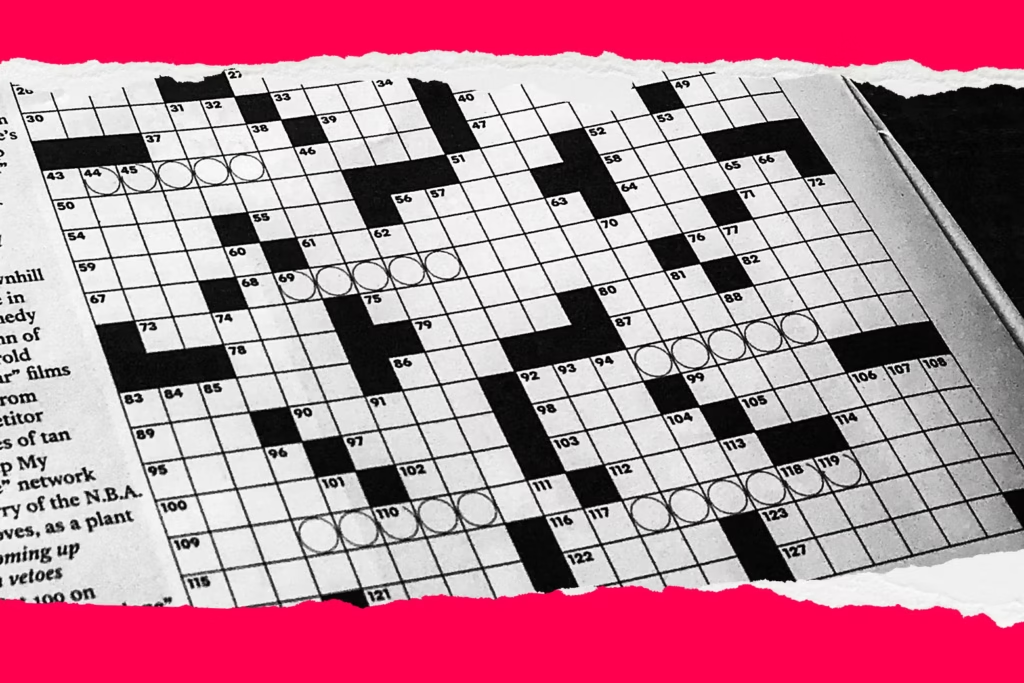

There you are, midway through a Monday or Tuesday New York Times crossword puzzle, and you hit a deceptively short clue: “Be furious.” Two words. That’s it. No extra context, no question mark, no clever misdirection. Just a direct emotional instruction — be furious — and a set of blank squares staring back at you.
If you’ve ever tapped your pencil on that clue and drawn a blank, you’re in excellent company. Anger-related clues are among the most frequently recurring in the be furious nyt crossword, and they come packaged in dozens of disguises. Knowing the handful of go-to answers — and understanding why crossword constructors love them — is one of the fastest ways to sharpen your solving speed.
This guide breaks down the “Be furious” clue from every angle: the most accepted answers, the broader family of synonyms constructors lean on, the linguistic mechanics behind emotion-based clues, and expert tips for tackling them confidently. By the end, you’ll never pause on a rage-related clue again.
What Does “Be Furious” Mean in Crossword Context?
In everyday English, furious sits near the top of the anger spectrum. It suggests intensity, heat, barely-contained energy. But in crossword-world, the phrase “Be furious” functions as a clue that asks for a verb — specifically, an action or state that expresses extreme anger.
The word “be” is the crucial grammatical signal here. The clue isn’t asking for an adjective (like “irate” or “livid”) — it’s asking for a verb phrase. When a clue begins with “Be,” constructors almost always want a verb in base form that fits the frame “I/you/they ___.” So “be furious” translates directly to: what do you do when you’re furious?
Crossword grammar tip: When a clue starts with “Be ___,” the answer is almost always a verb in base (infinitive) form. “Be furious” → a verb meaning to feel or express extreme anger. The tense of the clue matches the tense of the answer.
This grammatical constraint dramatically narrows the field. You’re not looking for “angry,” “enraged,” or “irate” — those are adjectives. You need a crisp, short verb that slots neatly into the grid. And in the NYT crossword, where brevity is king, a handful of compact options dominate.
The Most Common Answers
Based on historical be furious nyt crossword appearances, the clue “Be furious” most reliably resolves to one of two answers. The correct one for your specific puzzle will depend entirely on the number of letters and the crossing answers already filled in.
Primary Answer (5 letters)
SEETHE
To be in a state of intense, suppressed anger
SEETHE is the star of the show here. Six letters in standard usage, but more commonly appearing as a 6-letter answer — wait, let’s count: S-E-E-T-H-E. That’s six letters. It shows up with remarkable frequency against clues like “Be furious,” “Simmer with anger,” “Boil inwardly,” and “Be livid.” The beauty of SEETHE from a constructor’s perspective is that it’s vivid, phonetically satisfying, and rich in crossing consonants (S, T, H) that play well with other words in the grid.
Common Alternative (4 letters)
FUME
To be filled with anger; to emit fumes of rage
FUME is the four-letter companion answer and arguably even more versatile. It does double duty in crossword grids: it can mean to give off smoke or vapor (literal) or to be intensely angry (figurative). That dual meaning makes it a favorite for constructors who love clues that hint at one meaning while the grid context confirms another. When the answer space is four squares and anger is the theme, FUME is almost always the answer.
Other confirmed appearances include RAGE (4 letters), which works both as a noun and a verb, and STEAM (5 letters), which taps into the same boiling/simmering metaphor as SEETHE. Less frequently, you might see BURN or SIMMER depending on how the clue is phrased.
Synonyms & Alternate Answers to Know
Crossword constructors are creative people who rarely repeat the exact same clue twice. The concept of being furious, however, recurs constantly — just dressed in different clothing. Expanding your synonym bank for “anger as a verb” is one of the highest-ROI moves a crossword solver can make. Here are the key words to keep in your mental arsenal:
SEETHEFUMERAGEBURNSTEAMSMOLDERSIMMERBOILCHAFEBRISTLE
Notice a pattern? Many of these words are drawn from the world of heat and combustion: seething, fuming, burning, simmering, boiling. This isn’t a coincidence — the English language has long mapped anger onto the metaphor of heat and pressure, and crossword constructors exploit this richly. A clue like “Steam with anger” or “Boil with rage” is pointing at the same emotional territory as “Be furious,” just through a slightly different metaphorical door.
BRISTLE and CHAFE are the outliers here — they suggest irritation and defensiveness more than full-blown fury. You’ll see them paired with softer clues like “Be annoyed” or “Show irritation.” Understanding where on the anger spectrum a clue sits helps you triage between answers when the letter count gives you multiple options.
Tips for Solving Emotion-Based Crossword Clues
Emotion clues are some of the most consistent in the be furious nyt crossword precisely because human emotional vocabulary is finite and well-mapped. Here are the strategies that experienced solvers use to crack them quickly:
01
Count the letters first. 4 letters and “Be furious”? Almost certainly FUME or RAGE. 6 letters? SEETHE is your prime suspect. Start with letter count, not linguistic guessing.
02
Note the grammar signal. “Be ___” clues want verbs. “Feeling ___” wants an adjective. “State of ___” may want a noun. Match your answer’s part of speech to the clue’s grammatical structure.
03
Use crossings aggressively. Emotion verbs share common letters (S, E, R, A, M). Fill in crossing answers first to isolate which starting letter the emotion clue needs — that often clinches it instantly.
04
Think in metaphor families. Anger clues cluster around heat (SEETHE, BURN, BOIL), pressure (FUME, STEAM), and agitation (RAGE, BRISTLE). When stuck, mentally walk through each family.
Another underrated tip: day of the week matters. The NYT crossword scales in difficulty from Monday (easiest) to Saturday (hardest), with Sunday being large but medium-difficulty. “Be furious” appearing on a Monday almost certainly points to the most common, obvious answer. The same clue on a Thursday might be hiding a wordplay twist — perhaps the answer has a rebus component, or the “furious” is metaphorical in a different way than you’d expect.
Why the NYT Crossword Loves Anger Clues
It might seem odd that a prestigious newspaper puzzle leans so heavily on the vocabulary of rage and frustration. But there are concrete reasons why emotion clues — especially anger — recur so often in American crosswords.
First, the letter efficiency is extraordinary. Words like FUME, RAGE, and SEETHE are short, consonant-rich, and vowel-balanced in ways that make them gridworthy gold. Constructors building a 15×15 grid need fill words that don’t create impossible crossing patterns, and anger verbs tend to be cooperative neighbors.
Second, semantic clarity. Unlike happiness (which has dozens of vague synonyms) or sadness (MOPE? PINE? GRIEVE?), anger in its intense form clusters around a tight set of vivid verbs. FUME, SEETHE, RAGE — these are unambiguous. A solver who knows the answer and counts the letters will almost always arrive at the same word, which makes for fair, satisfying puzzle construction.
Third, there’s the metaphor richness. Because anger maps so cleanly onto heat and combustion in English, constructors can clue the same answer through multiple metaphorical frames: “Steam up,” “Boil over (with anger),” “Simmer,” “Be on fire (with rage).” This flexibility makes anger verbs some of the most reusable entries in the constructor’s toolkit.
The New York Times crossword, now edited by Joel Fagliano (who took over from the legendary Will Shortz), has a documented fondness for emotion-based clues precisely because they test linguistic intuition rather than obscure trivia. You don’t need to know a capital city or a chemical element — you need to know how humans feel and how English describes those feelings. That’s an equalizing kind of difficulty, accessible to solvers of all backgrounds.
A Brief History of the NYT Crossword
No guide to the be furious nyt crossword would be complete without a nod to the puzzle’s remarkable history. The New York Times crossword debuted on February 15, 1942, introduced during World War II partly as a morale-boosting diversion for readers coping with wartime anxiety. The first puzzle was edited by Margaret Farrar, who became the crossword’s first editor and held the role for nearly three decades.
Under Farrar’s stewardship, and later under editors Eugene T. Maleska and the iconic Will Shortz (who took over in 1993 and remains perhaps the world’s most famous puzzle editor), the NYT crossword evolved into the gold standard of American wordplay. Shortz, the only person in the world known to hold a degree in enigmatology (the study of puzzles) from Indiana University, brought a new era of thematic creativity, inclusive vocabulary, and cultural relevance to the puzzle.
Today, the NYT crossword publishes seven puzzles a week, has a digital subscriber base in the millions (through the NYT Games app), and generates a passionate community of daily solvers, speed-solving competitors, and puzzle constructors. Clues like “Be furious” are, in their way, load-bearing pillars of this institution — reliable, recurring, satisfying to crack.
Final Thoughts
The clue “Be furious” is a perfect little window into what makes the New York Times crossword simultaneously simple and deeply satisfying. On the surface it’s just two words. Underneath, it’s a test of your grammatical instincts, your emotional vocabulary, your metaphor literacy, and your pattern recognition from previous puzzle experience.
Next time you encounter this clue, run the quick mental checklist: How many letters? Does the grid suggest a vowel-heavy or consonant-rich word? What crossing letters do I already have? In most cases, SEETHE or FUME will be your answer — and now you know exactly why.
The NYT crossword has been a daily companion to millions of readers for over 80 years, and clues like this one are part of the reason. They’re fair, elegant, and just challenging enough to make the aha moment feel earned. Happy solving.
Frequently Asked Questions (FAQs)
What is the most common answer for “Be furious” in the NYT crossword?↓
The most common answers are SEETHE (6 letters) and FUME (4 letters). Which one applies to your puzzle depends on the number of blank squares. SEETHE is slightly more frequent for this specific phrasing, while FUME appears more often across a broader family of anger-related clues.
Can “Be furious” ever be answered with RAGE?↓
Yes — RAGE (4 letters) is a valid answer and appears occasionally. However, constructors tend to use RAGE more often as a noun clue (“Intense anger,” “Fit of temper”) than as a verb clue. For verb-form clues like “Be furious,” FUME and SEETHE are more standard choices.
Why do crossword clues about anger appear so frequently?↓
Anger verbs are crossword-friendly because they are short, consonant-rich, vowel-balanced, and unambiguous. Words like FUME, SEETHE, and RAGE make excellent grid fill because they create workable crossing patterns and have clear, singular meanings. They also recur naturally because constructors have many ways to clue them through the rich English metaphor of heat and combustion.
How do I know if a crossword clue wants a verb or an adjective?↓
Look at the clue’s grammatical structure. Clues beginning with “Be ___” signal a verb answer (in base/infinitive form). Clues like “Feeling ___” or “Looking ___” signal adjectives. Noun-form clues tend to use “State of ___” or simply name the emotion without a linking verb. Matching the answer’s part of speech to the clue is one of the fundamentals of crossword solving.
What is the difference between SEETHE and FUME in meaning?↓
Both mean to be intensely angry, but with subtle nuances. SEETHE implies suppressed, inward anger — the kind that boils under the surface without visible explosion. FUME suggests anger that’s more visibly expressed, with an emphasis on outward agitation. In crossword usage, this distinction rarely matters — both serve as answers to broadly-worded anger clues.
Are NYT crossword clues reused across different puzzles?↓
Yes, clue-answer pairings are reused, but constructors and editors try to vary the exact wording over time. “Be furious,” “Simmer with anger,” “Boil inwardly,” and “Show rage” may all point to the same answer — SEETHE — across different puzzles published years apart. Experienced solvers build a mental database of these recurring pairings.
Does the day of the week affect how “Be furious” is clued?↓
Absolutely. On a Monday or Tuesday, the clue will almost certainly resolve to a straightforward answer like FUME or SEETHE. Later in the week (Thursday–Saturday), the same conceptual territory might come packaged with a twist — a wordplay element, an unusual secondary meaning, or a tricky rebus. Always factor in the day when interpreting a clue’s expected difficulty level.
How can I get better at solving NYT crossword clues quickly?↓
The single best practice is consistency: solve the puzzle daily, starting with Monday and working your way to harder days as your skill grows. Build a personal vocabulary list of recurring answers (like SEETHE and FUME). Study common crossword-ese — the special vocabulary crosswords favor. Use crossing letters aggressively. And when stuck, mentally scan common grammatical patterns (noun? verb? adjective?) to narrow the field before guessing.